
Gate & Garden shares practical, down-to-earth guidance on garden gates, fencing and outdoor access for readers across the UK.
- 0123456789
- Angle Bd Abdelmoumen & rue soumaya, Résidence
- [email protected]
Gate & Garden shares practical, down-to-earth guidance on garden gates, fencing and outdoor access for readers across the UK.
 By Eleanor Whitcombe
There is something deeply reassuring about a cottage garden. It is not pristine or regimented, and it makes no apologies for spilling over the edges of the path. At its heart is a simple idea: a small patch of ground, carefully tended, that welcomes you in. And the gateway is where that welcome begins.
A picket gate, a scramble of climbing roses and a gravel path crunching underfoot will get you most of the way there. But the details matter more than most people expect. Get the gate height wrong, or choose a fence that fights with the planting, and the whole scene can feel flat. Get it right and the effect is effortless, as though the garden has always been there.
The classic cottage gate is a timber picket, but not all pickets are equal. Look for a gate around 900mm to 1m high for a front garden, and closer to 1.8m if it needs to offer real privacy at the side or back of the house. Low gates feel inviting; tall ones feel defensive, so use them where the job genuinely needs doing.
Picket width and spacing change the character of the gate considerably. Wider boards with narrow gaps read as sturdy and traditional, particularly in a rural setting. Slimmer, closely spaced pickets feel lighter and more ornamental. A gentle curve along the top rail softens the silhouette and lets the planting behind show through, which is exactly what you want when roses are scrambling over it.
Timber choice matters too. Pressure-treated softwood is the practical option and takes paint beautifully, while oak or sweet chestnut will weather to a soft silver-grey and last for decades without any finish at all. If you plan to paint, softwood is the sensible choice. If you want the gate to age quietly into the planting, go for a durable hardwood and leave it bare.
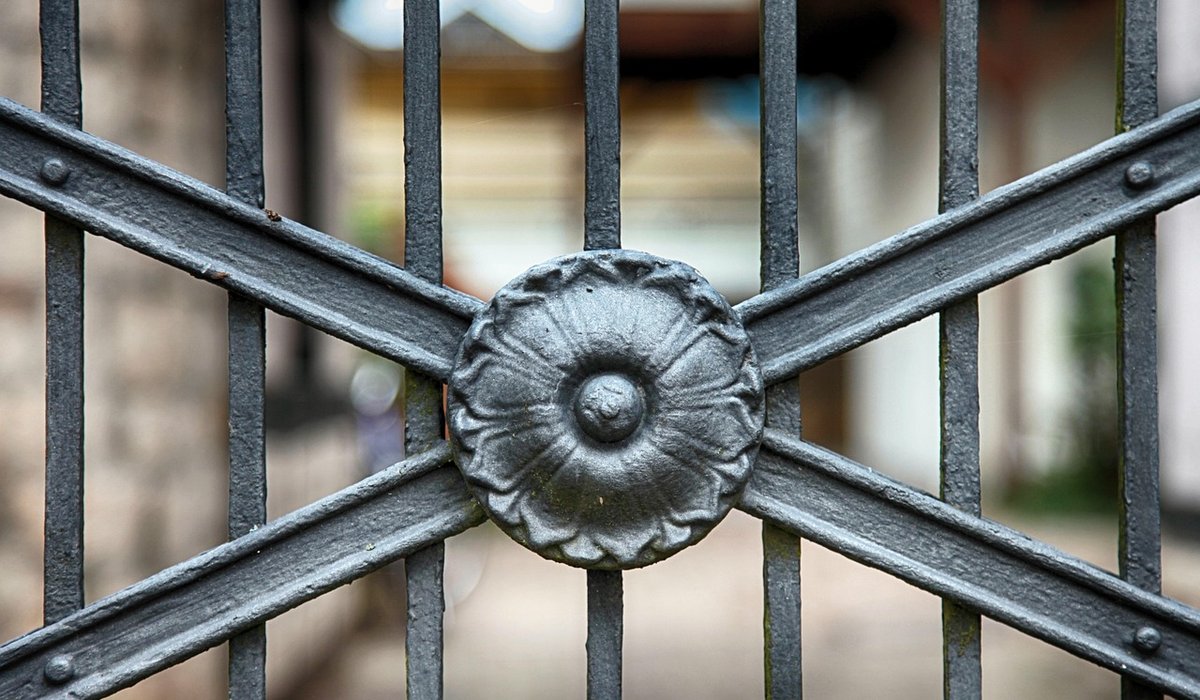
Ironwork has its place as well. A simple wrought-iron gate suits a period cottage, especially alongside brick or flint walls, but it needs more planting around it to stop it feeling municipal. Pair it with lavender, jasmine or a loose hedge and it will settle in nicely.
Fencing should frame the garden rather than dominate it. For cottage borders, low timber hurdles in hazel or willow are hard to beat. They are woven, slightly irregular and soften beautifully as moss and climbers move in. They also cast lovely dappled shadows across a path in the afternoon.
Whatever you choose, keep the height consistent with the gate. A tall fence next to a low gate looks unbalanced, and a low fence beside a tall gate undermines the privacy you paid for. If in doubt, let the gate sit slightly lower than the fence line so it reads as a deliberate opening.
The path does more work here than most people realise. A gently curving gravel or hoggin path draws the eye from the gate to the front door and gives the planting something to lean into. Straight lines feel formal; a soft S-curve feels like a cottage.
Lay the gravel at around 50mm deep over a compacted sub-base, and use a stabilising grid if the path takes heavy foot traffic or a wheelbarrow. For edging, nothing beats reclaimed brick, clay pavers or a simple row of cobbles set on edge. Avoid rigid concrete kerbs, which tend to look sharp and new against loose planting.
If the ground is shady, consider bark or a mown grass path instead. Grass paths work beautifully in cottage gardens provided you keep the edges crisp with a half-moon edger, and they are far more forgiving underfoot in wet weather.
This is where the cottage look is won or lost. The trick is to let plants soften the hard edges without swamping the gate itself. Aim for a relaxed frame: something scented at nose height, something vertical behind, and something low spilling onto the path.
Resist the urge to plant right against the gate swing. Leave at least 300mm of clearance so the gate opens freely and the plants do not get bruised every time someone comes through.
Cottage gardens reward restraint in colour. Soft greens, off-whites, pale blues and muted greys work best for gates and fences, because they sit back and let the flowers do the talking. A deep sage green is a reliable choice, as is a chalky off-white that picks up the tone of a gravel path.
If you do paint, sand lightly between coats, use a primer on bare softwood, and expect to refresh it every three to five years. Avoid high-gloss finishes; a matt or eggshell look suits weathered timber far better. Handles and hinges should be simple and understated, ideally black iron, brass or aged pewter.
Finally, pay attention to the small things: a well-oiled latch, a gate that swings true, a bootscraper set into the path, and a lantern or wall light on the house wall. These are the details that turn a tidy boundary into a garden that feels genuinely lived in, welcoming you home every time you push the gate open.


We are not gonna make spamming
